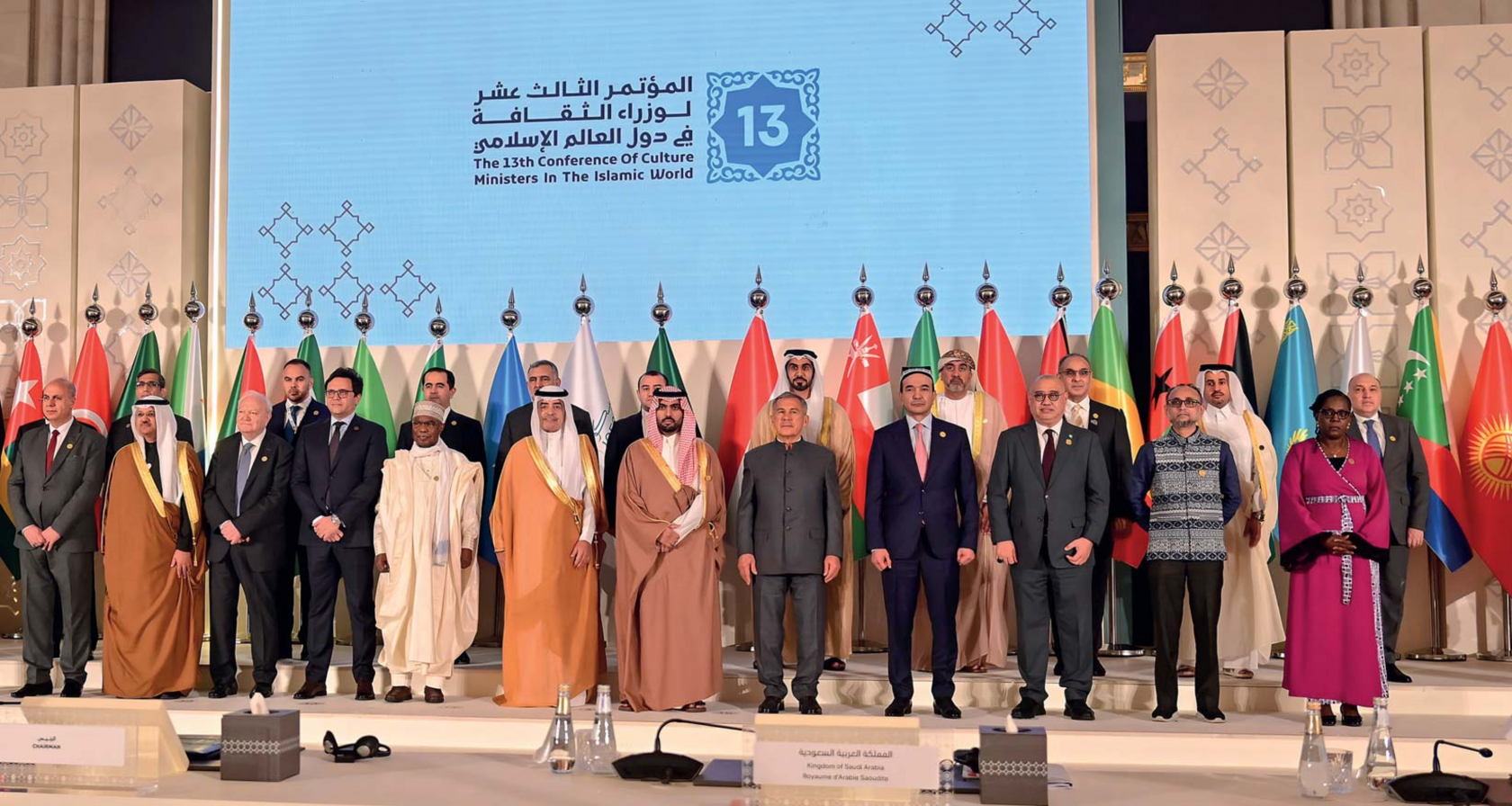
This material was compiled by the Ministry of Culture of the Republic of Tatarstan Press Office
The Republic of Tatarstan boasts one of the most sophisticated cultural infrastructures in Russia, comprising 182 museums, some 1,500 libraries, 19 theatres, a circus, and 20 concert organisations.
KAZAN—THE 2026 CULTURAL CAPITAL OF THE ISLAMIC WORLD
The Cultural Capital of the Islamic World status is conferred upon cities that serve as bridges of mutual understanding, where historical heritage becomes a living language of interstate dialogue. In 2026, this distinguished mission falls to Kazan—a city that for over a millennium has stood as a unique centre where cultures, religions, and artistic traditions amalgamate. For the Republic of Tatarstan, where Islam and Orthodox Christianity have coexisted for centuries in peace and mutual respect, this recognition by the OIC and ICESCO represents the culmination of sustained, systematic work in preserving spiritual heritage and fostering humanitarian ties with the Islamic world.
FROM VOLGA BULGARIA TO PRESENT DAY: A THOUSAND-YEAR TRADITION
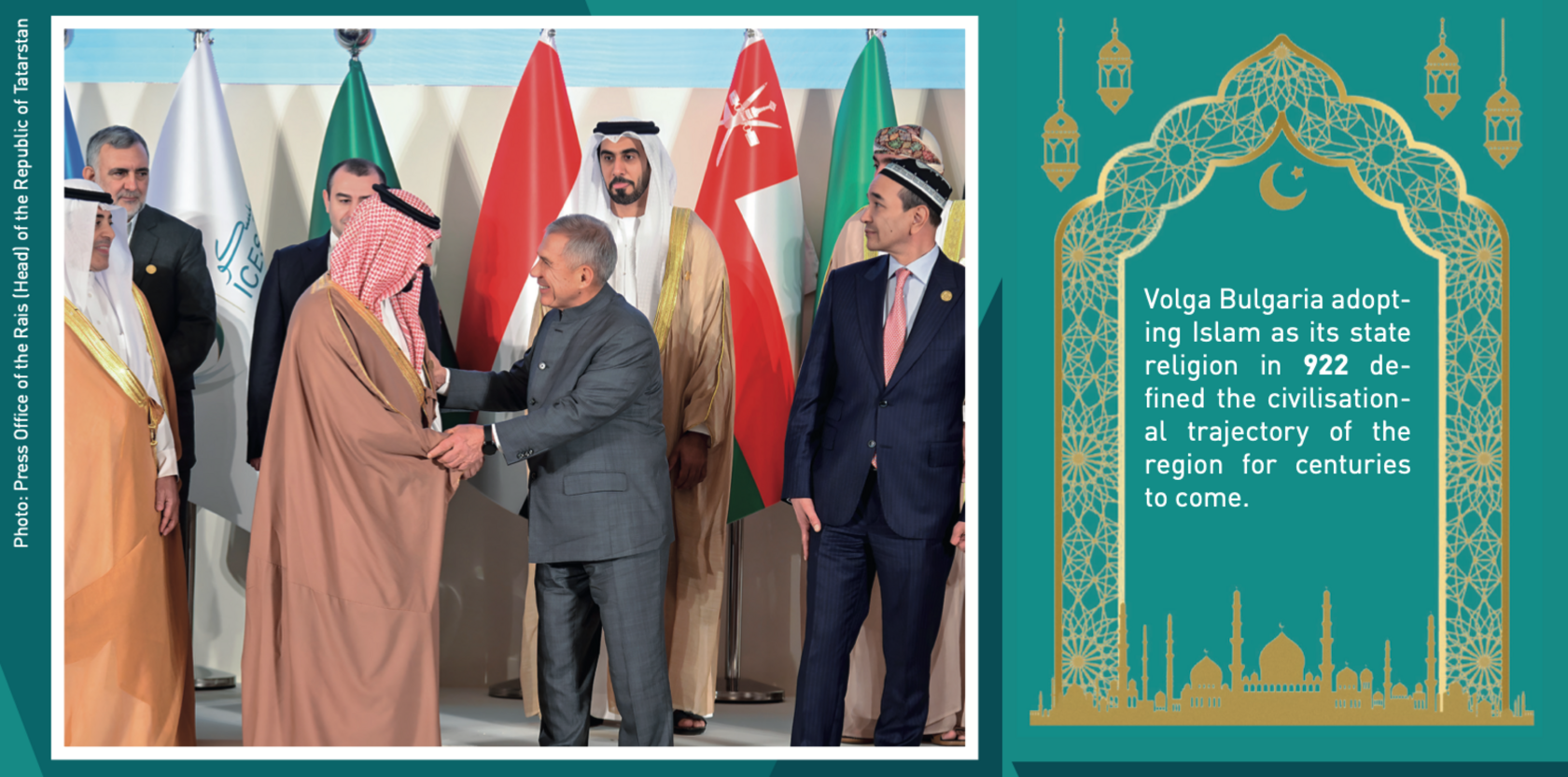
The history of Kazan is closely intertwined with the era of Volga Bulgaria—in 922 it was the first in north-eastern Europe to adopt Islam as the state religion. This event defined the civilisational trajectory of the region for centuries to come. Bulgar cities, prominent among which were Bilyar and Bolgar itself, became centres of scholarship, craftsmanship, and the arts. It was here, in the 12th century, that the outstanding literary and theological work “The Beauty of Gardens and the Consolation for Suffering Hearts” by Daud al-Suvari was composed—a text preserved in manuscript form and printed in the modern era.
The year 2033 is to see celebrations marking the 850th anniversary of the birth of the Bulgar-Tatar poet Qul Ghali and the 800th anniversary of his renowned work “Qissa-i Yusuf” (Tale of Yusuf). This poem, which artistically embodies the ideals of the perfect human being and the just ruler, has for centuries remained a spiritual lodestar for the Turkic peoples.
A rich manuscript tradition flourished in medieval Kazan—the capital of the Kazan Khanate. Today, the holdings of the Scientific Library of Kazan Federal University comprise over 20,000 Arabic-script texts in the Old Tatar, Arabic, and Persian languages. The National Library of the Republic of Tatarstan preserves in excess of 10,000 such manuscripts, whilst the Centre for Written Heritage of the Academy of Sciences of the Republic of Tatarstan holds a further approximate 8,000. Among these treasures is the celebrated dastan“Idegei,”aworkthatbridgesthe literary and oral traditions. It was in Kazan, in 1803, that the Qur’an was printed for the first time in the world in an edition verified by Muslim scholars—the “Kazan Basmasi” became the definitive standard edition, disseminated throughout the entire ummah.
The Republic of Tatarstan is home to four UNESCO World Heritage Sites: the Kazan Kremlin, the Bolgar Historical and Archaeological Complex, Assumption Cathedral of the Sviyazhsk Museum-Reserve, and the two astronomical observatories of Kazan Federal University.
TREASURES GUARDED BY UNESCO
Kazan’s and Tatarstan’s prominence in world culture finds confirmation in four UNESCO World Heritage Sites. Foremost among these is the Kazan Kremlin, inscribed on the List in 2000. This unique ensemble bears witness to historical continuity and cultures intermingling: standing in juxtaposition here are the Annunciation Cathedral (16th century) and the Kul Sharif Mosque, reconstructed at the dawn of the 21st century, alongside the legend-shrouded Söyembikä Tower and ancient archaeological strata that chart five distinct phases of the city’s development.
The Bolgar Historical and Archaeological Complex constitutes yet another UNESCO World Heritage Site—a place of pilgrimage for Muslims across Eurasia, where the spiritual aura of the ancient capital remains palpable to this day. In 2014, the UNESCO Committee observed that Bolgar represents “the historical cultural exchanges and transformations of Eurasia” and “one of the brightest examples of medieval culture of the Muslim Renaissance Era.” The Assumption Cathedral of the island town of Sviyazhsk, inscribed on the List in 2017, has become a symbol of the architectural traditions of Northern and Central Russia converging with the local traditions of the Volga-Urals region; its 16th-century frescoes are of exceptional artistic significance.
In 2023, the Astronomical Observatories of Kazan University—the Urban Observatory and the suburban Engelhardt Observatory—joined this List, thereby confirming the region’s contribution to science.
DIVERSITY-BASED IDENTITY
Kazan has long been referred to as the “multicultural” capital, and this is by no means a mere figure of speech. Over the centuries, a unique environment has taken shape here, wherein Russian and Tatar cultures, as well as Islam and Orthodox Christianity, do not merely coexist but actively enrich one another.
This dialogue has found vivid expression in the arts: Kazan was the birthplace of Fyodor Chaliapin, whose voice captivated the world. It was here that the poets Gavrila Derzhavin, Yevgeny Boratynsky, and Velimir Khlebnikov, as well as the artists Nikolai Fechin, Baqi Urmançe, and Konstantin Chebotarev, pursued their creative endeavours.
Kazan University, founded in 1804, long remained the easternmost classical university in Europe and a pre-eminent centre of Oriental studies. It was here that Lobachevsky’s non-Euclidean geometry was conceived, Butlerov’s theory of chemical structure developed, and the element ruthenium discovered. It was likewise within the walls of this university that a scholarly tradition took root which focuses on the study of the languages, history, and culture of the Islamic world.
An important milestone was the emergence of professional Tatar theatre in 1906—the first of its kind among Muslim peoples. The Musa Dzhalil Opera and Ballet Theatre, the Galiaskar Kamal Tatar Academic Theatre, and the Karim Tinchurin Drama and Comedy Theatre are today renowned far beyond Russia. Annual international festivals—the Chaliapin Opera Festival, the Nureyev Ballet Festival, the “Nauruz” Theatre Festival, and the “Altyn Minbar” Film Festival—draw maestros from across the globe and affirm Kazan’s standing as an open and vibrant cultural platform.
MODERN INFRASTRUCTURE AND BEYOND
Today Kazan and The Republic of Tatarstan boast one of the most sophisticated cultural infrastructures in Russia. The Republic has 182 museums, with 34 of them in Kazan alone, among them the National Museum of the Republic of Tatarstan (founded in 1894, it houses the largest medieval hoard in Eastern Europe—the Karatun Hoard of 24,103 coins) and the first branch of the State Hermitage Museum in Russia—the Hermitage–Kazan Centre. The Museum of Fine Arts of the Republic of Tatarstan, accommodated within the former mansion of General Sandetsky, and the National Art Gallery “Khazine” present exceptionally rich collections ranging from ancient artefacts to avant-garde works. An extensive network of museum-reserves has been established across the Republic—including the Bolgar, Yelabuga, the island town of Sviyazhsk, Kazan Kremlin, Bilyar, Iske-Kazan, and Chistopol reserves—which together welcome millions of visitors annually. The total museum holdings of Tatarstan exceed 2.2 million items, of which 1.6 million constitute objects within the core collection.
The Republic’s theatrical and entertainment network comprises 19 theatres, a circus, and 20 concert organisations, including symphony and chamber orchestras, song and dance ensembles, as well as jazz bands.
Nearly 1,500 libraries are integrated into a centralised library system, whose holdings amount to approximately 25 million items, including 14,000 rare books and manuscripts. The Republic is home to 141 children art schools. The system of professional education is further supplemented by 9 colleges and 2 higher education institutions, in which more than 5,000 students are enrolled.
BRIDGE BETWEEN WORLDS
For Kazan the year as the Cultural Capital of the Islamic World will not be merely a period of momentous events but also an impetus for further developing dialogue. The Republic of Tatarstan already possesses a successful track record in hosting major international forums—the KazanForum and the BRICS Summit 2024 among them—where issues of culture are invariably of singular importance.
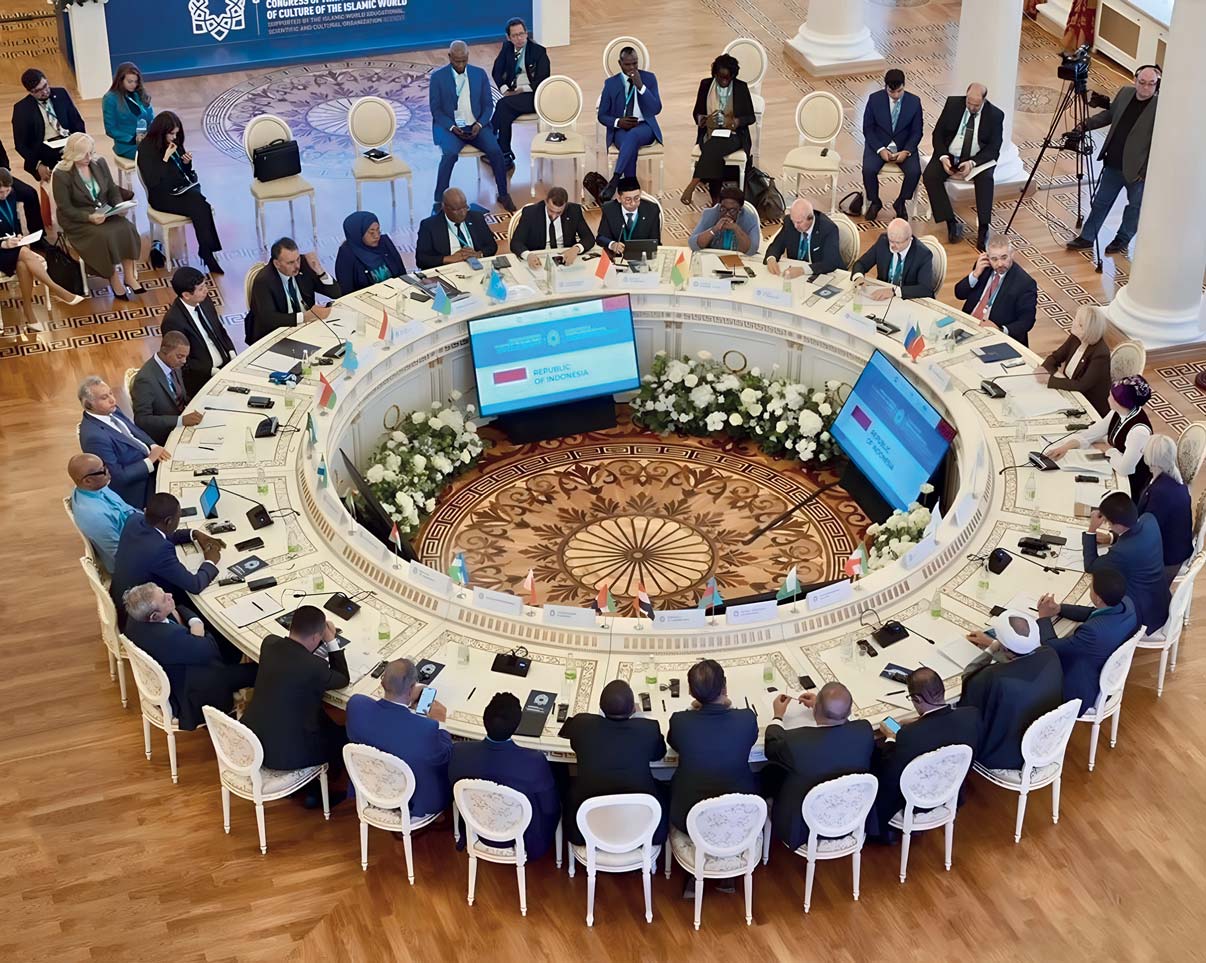
Last year, for the first time in Russia’s history, OIC culture ministers meeting was hosted by Kazan, welcoming representatives from 18 countries as well as three international organisations.
Kazan seamlessly combines its role as a centre of scholarship and education, a platform for economic cooperation, and a magnet for creative forces.
At the heart of this role lies the capacity to preserve traditions without becoming insular, and to cultivate contemporary forms of artistic expression whilst remaining faithful to spiritual origins. A reverent stewardship of ancient manuscripts alongside support for young calligraphers, the restoration of historic monuments alongside the creation of new public spaces, classical music alongside experimental stage productions—all fostering an environment in which equitable cross-cultural dialogue becomes a natural language of communication.
The recognition of Kazan as the Cultural Capital of the Islamic World constitutes an acknowledgement of its thousand-year mission to serve as a meeting point of civilisations. In 2026, Kazan bears this title with honour, opening its museums, theatres, libraries, and its heart to guests from across the globe.