
Marina LARIONOVA, Head of the Centre for International Institutions Research, Institute for Applied Economic Research, Russian Presidential Academy of National Economy and Public Administration (RANEPA)
Russia, its BRICS partners, and a number of G20 members stand for digital sovereignty and cooperation aimed at establishing a fair, inclusive, and equitable AI governance.
GLOBAL AI GOVERNANCE: MODERN CHALLENGES
The emergence of a multipolar world is intrinsically linked to the transformation of the global economic governance system. As the balance of power in the world economy shifts and international institutions undergo modernisation, competition over who will steer the reform and establishment of new governance mechanisms intensifies. The United States and its allies resist any attempts to reform the governance architecture built to gain access to global economy and its resources through a system of multilateral institutions and rules1. The beneficiaries of the old regime, seeking to maintain their influence over the Bretton Woods institutions and to shape a new economic order tailored to their interests, are engaged in a concerted effort within key international bodies and bilateral relations with a wide range of partners.
Efforts to thwart reforms of the international monetary and financial system, to reshape the rules of international trade, and to establish new climate governance structures are now being complemented by actions aimed at shaping digital economy and artificial intelligence governance. Given AI’s unique impact across politics, economy, and international cooperation, influence over global AI governance will become a decisive factor in the balance of power within the future global economic system. Consequently, developed nations strive to secure dominance in setting AI standards, norms and regulations concerning its development, application, and oversight.
Russia, our BRICS partners, and the emerging economies within the G20 promote policies of digital sovereignty and cooperation aimed at establishing a just, inclusive and equitable AI governance with the UN at its core and the interests of all nations taken into account. Despite a formal universal support in the key texts across a wide array of multilateral bodies, the goal of the participants differ drastically. These contradictions are manifest in shared platforms, notably the UN and the G20.
Efforts to thwart reforms of the international monetary and financial system, to reshape the rules of international trade, and to establish new climate governance structures are now being complemented by actions aimed at shaping digital economy and artificial intelligence governance. Given AI’s unique impact across politics, economy, and international cooperation, influence over global AI governance will become a decisive factor in the balance of power within the future global economic system. Consequently, developed nations strive to secure dominance in setting AI standards, norms and regulations concerning its development, application, and oversight.
Russia, our BRICS partners, and the emerging economies within the G20 promote policies of digital sovereignty and cooperation aimed at establishing a just, inclusive and equitable AI governance with the UN at its core and the interests of all nations taken into account. Despite a formal universal support in the key texts across a wide array of multilateral bodies, the goal of the participants differ drastically. These contradictions are manifest in shared platforms, notably the UN and the G20.
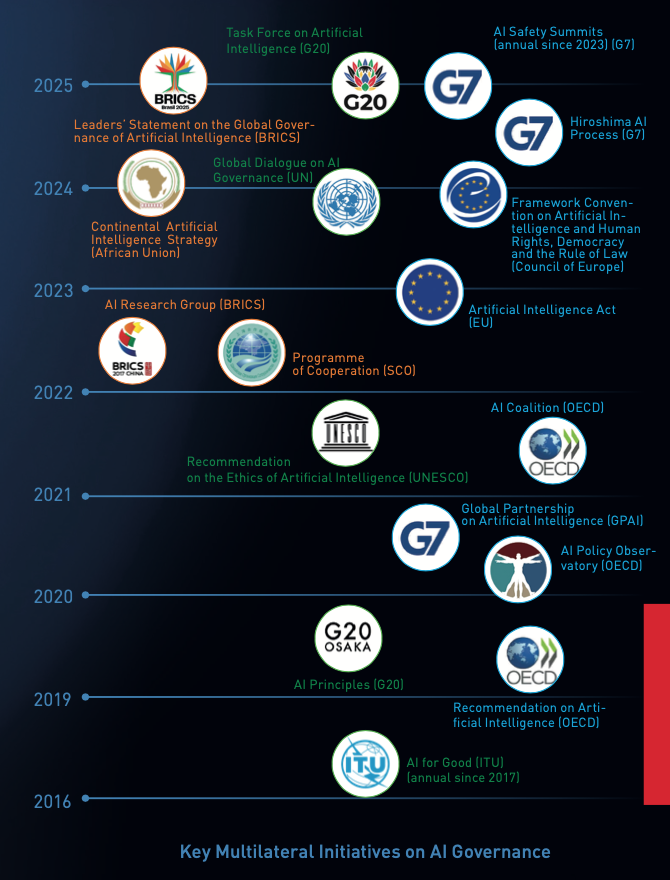
Within the UN process launched in 2025 to establish global AI governance, disagreements centred on the nature and scope of the key mechanisms—namely, the Global Dialogue on AI Governance and the Independent International Scientific Panel on AI. Disputes have arisen over the mandate powers of the co-chairs and the anticipated outcomes of the dialogue. The Western countries, including NGOs and technological corporations, lead the negotiations on the UN platform. Developing countries’ representatives’ fall short in capabilities and degree of influence. As a result, the process of drafting a resolution on AI governance by 2027 carried significant risks of adopting a document that would cement the competitive advantages of Western companies, deepen inequalities, and foster new forms of technological dependency. Following consultations, the mandate of the Global Dialogue was significantly scaled back: its co-chairs will now focus on intergovernmental consultations to develop a shared understanding of priority issues in international AI governance. Nevertheless, the risks persist that the UN process will support building an international AI governance ecosystem that entrenches the overwhelming influence of Western-centric structures—such as the OECD, the Global Partnership on Artificial Intelligence (GPAI), the G7, the Council of Europe, and various national and regional initiatives. Analysis shows that these mechanisms already wield considerable influence, amplified by network effects, and are often highly politicised, with their agendas largely shaped by industry interests.
Launched by the G7 in 2018, the GPAI is positioned as an alliance that brings together developed and developing nations, focusing on the engagement of expert centres and business, and cooperation with international organisations, including the G20 and UN bodies, to foster credible AI grounded in the OECD AI Principles. By 2025, the partnership brought together 44 member states—predominantly G7 and OECD countries, the former providing the platform for GPAI’s operations. India and Brazil from the BRICS group are active participants. All in all, the GPAI functions as an institutional mechanism for expanding the G7’s collaborative network, designed to nurture shared approaches and amplify its influence over the parameters of AI governance.
Since 2023, the G7 together with the OECD, the GPAI and the International Forum on AI Governance, have been driving a structured initiative known as the Hiroshima Process. Its aim is to establish mechanisms and rules for global AI governance rooted in G7 norms and values, leveraging the OECD’s structures and expertise. The declared objective of the Process is to forge an inclusive AI governance system capable of addressing risks, protecting society and upholding shared democratic values. The G7 has been actively bringing other countries and stakeholders on board. By early 2025, the list of states had grown to 56, including India and the UAE.
AI summits function as another means of engaging a wide range of countries in shaping an AI governance system based on the Hiroshima principles and values. The 2023 AI Safety Summit focused on the first track of the Hiroshima Process: identifying and mitigating the risks associated with the development and deployment of advanced AI systems. The declaration was signed by 30 countries, including several BRICS members—Brazil, China, India, Indonesia, South Africa, and the UAE.
The follow-up summit in 2024 produced the Seoul Declaration for Safe, Innovative, and Inclusive AI. While the list of attendees was broader—including, among others, China, India, Saudi Arabia and the UAE—the signatories to the Declaration were the G7 members, along with Australia, Korea and Singapore.
The 2025 Paris AI Action Summit, co-chaired by French President Emmanuel Macron and Indian Prime Minister Narendra Modi, concluded with a declaration endorsed by representatives of 61 countries. Notably the final document was not signed by the United States and the United Kingdom.
The OECD provides analytical support for policy discussions aimed at developing common approaches, norms and policy instruments among its leading members. Its Recommendation on Artificial Intelligence, adopted in May 2019, is positioned as the first intergovernmental standard on AI—a foundation for building a regulatory environment and standards that promote responsible AI governance, consistent with human rights and democratic values.
It sets out five principles for responsible AI management, along with guidelines for translating these principles into national policy and international cooperation (BRICS members Brazil and Egypt have adhered to the Recommendation). These principles are progressively being incorporated into the expert work and practice of international organisations. The G20 endorsed these principles in 2019, and in 2020 the recom-mendations on national policy and international cooperation based on the OECD document. The accession of non-OECD countries and the G20 endorsement have legitimised the OECD Recommendation as a basis for broad international cooperation.
Launched by the G7 in 2018, the GPAI is positioned as an alliance that brings together developed and developing nations, focusing on the engagement of expert centres and business, and cooperation with international organisations, including the G20 and UN bodies, to foster credible AI grounded in the OECD AI Principles. By 2025, the partnership brought together 44 member states—predominantly G7 and OECD countries, the former providing the platform for GPAI’s operations. India and Brazil from the BRICS group are active participants. All in all, the GPAI functions as an institutional mechanism for expanding the G7’s collaborative network, designed to nurture shared approaches and amplify its influence over the parameters of AI governance.
Since 2023, the G7 together with the OECD, the GPAI and the International Forum on AI Governance, have been driving a structured initiative known as the Hiroshima Process. Its aim is to establish mechanisms and rules for global AI governance rooted in G7 norms and values, leveraging the OECD’s structures and expertise. The declared objective of the Process is to forge an inclusive AI governance system capable of addressing risks, protecting society and upholding shared democratic values. The G7 has been actively bringing other countries and stakeholders on board. By early 2025, the list of states had grown to 56, including India and the UAE.
AI summits function as another means of engaging a wide range of countries in shaping an AI governance system based on the Hiroshima principles and values. The 2023 AI Safety Summit focused on the first track of the Hiroshima Process: identifying and mitigating the risks associated with the development and deployment of advanced AI systems. The declaration was signed by 30 countries, including several BRICS members—Brazil, China, India, Indonesia, South Africa, and the UAE.
The follow-up summit in 2024 produced the Seoul Declaration for Safe, Innovative, and Inclusive AI. While the list of attendees was broader—including, among others, China, India, Saudi Arabia and the UAE—the signatories to the Declaration were the G7 members, along with Australia, Korea and Singapore.
The 2025 Paris AI Action Summit, co-chaired by French President Emmanuel Macron and Indian Prime Minister Narendra Modi, concluded with a declaration endorsed by representatives of 61 countries. Notably the final document was not signed by the United States and the United Kingdom.
The OECD provides analytical support for policy discussions aimed at developing common approaches, norms and policy instruments among its leading members. Its Recommendation on Artificial Intelligence, adopted in May 2019, is positioned as the first intergovernmental standard on AI—a foundation for building a regulatory environment and standards that promote responsible AI governance, consistent with human rights and democratic values.
It sets out five principles for responsible AI management, along with guidelines for translating these principles into national policy and international cooperation (BRICS members Brazil and Egypt have adhered to the Recommendation). These principles are progressively being incorporated into the expert work and practice of international organisations. The G20 endorsed these principles in 2019, and in 2020 the recom-mendations on national policy and international cooperation based on the OECD document. The accession of non-OECD countries and the G20 endorsement have legitimised the OECD Recommendation as a basis for broad international cooperation.
The EU Artificial Intelligence Act (Regulation (EU) 2024/1689 of June 13, 2024, laying down harmonised rules on AI2) is promoted as the global benchmark for AI regulation, though it is far from providing optimal solutions to contentious regulatory challenges. Its influence comes from its extraterritorial reach, as it applies to companies regardless of whether they are established within the EU or in a third country. The problems are related with the substantial number of decisions which are to be developed by the European Commission, with tech companies wielding considerable influence over the process, and European standardisation organisations playing a significant role in specifying the law. Contentious points include the criteria for classifying general-purpose AI systems and the differing requirements imposed on general-purpose models compared to those deemed to carry systemic risk, while providers of open-source AI models are effectively exempted from transparency obligations, unless their models are considered to pose a systemic risk. The Regulation does little to mitigate the risks of further market concentration of tech giants, nor does it adequately address concerns over access controls and competition.
Despite these shortcomings, many jurisdictions—including Russia’s BRICS partners—are already looking to the Act as a regulatory template. Simultaneously, the EU is strengthening its capacity to shape global AI governance through regional, bilateral and multilateral mechanisms— trade and technology councils, digital partnerships, digital and cyber dialogues, partnership agreements and free trade agreements—among which are Russia’s partners in BRICS and the G20.
Despite these shortcomings, many jurisdictions—including Russia’s BRICS partners—are already looking to the Act as a regulatory template. Simultaneously, the EU is strengthening its capacity to shape global AI governance through regional, bilateral and multilateral mechanisms— trade and technology councils, digital partnerships, digital and cyber dialogues, partnership agreements and free trade agreements—among which are Russia’s partners in BRICS and the G20.
The BRICS countries stated their intent to coordinate efforts to promote common approaches within international forums and the UN Global Dialogue on AI Governance, ensuring a meaningful role and participation for developing countries.
In 2024, the Council of Europe’s Framework Convention on Artificial Intelligence and Human Rights, Democracy and the Rule of Law was opened for signature. The instrument, signed by all G7 members, is hailed as the very first international legally binding treaty in this field. Its objective is to ensure that the activities of AI systems are fully consistent with human rights, democracy and the rule of law, while also fostering technological progress and innovation. Thus, the G7 and OECD members pursue a concerted strategy to craft and embed AI governance rules that reflect their own values and interests through a network of key institutions—including the UN, ITU, G20, and various regional and bilateral mechanisms.
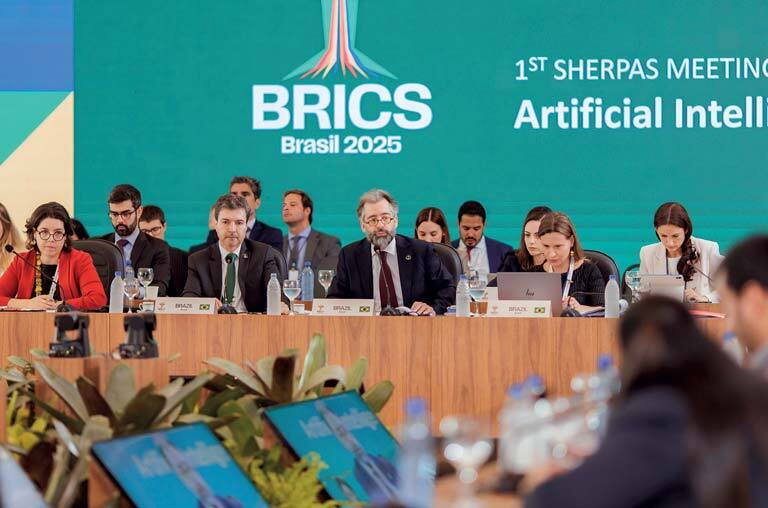
Developing countries are becoming increasingly conscious of the risks of “a fragmented approach to AI governance and overlapping initiatives dominated by the political narratives of a small group of countries, where the interests of lowand middle-income nations are overlooked.”3 Members of non-Western forums gradually strengthen dialogue aimed at shaping the character of global AI governance. However, these exchanges still lack the necessary scope and intensity. Within the EAEU, for instance, notwithstanding Russia’s efforts, the plan for AI cooperation for 2026– 2030 has only just been sketched out. A joint statement on the responsible development of AI within the EAEU is planned to be signed in 2026. The 3 Presentation on AI governance; BRICS — 1st Meeting of Sherpas, Sala Brasilia, 26 February 2025. members adopted a Programme of Cooperation between the authorised bodies of member states on AI development in 2022, with a focus on collaboration in AI research and application, joint research, investment, and co-production. Yet a roadmap for its implementation is still under consideration.
Within the G20, a complicated process is under way to reconcile the approaches of developed and developing members on the regulatory, structural and technological aspects of AI governance. The current status quo represents a compromise between the developed countries aspiration to advance their own rules, drawing on OECD recommendations and G7 decisions, and the G20 developing economies to rely on their own UN-oriented mecha-nisms and platforms. The emerging market and developing economies strive to avoid ideological contestation of AI cooperation and regulatory and technical standards that fail to reflect development needs, risking to create broader digital divides and engendering new dependencies.
Concrete steps to strengthen the influence of developing nations over the architecture of global AI governance were taken in 2025 at the BRICS Summit in Rio de Janeiro.
The Leaders’ Statement on Global AI Governance sets out a common approach to AI governance, the guidelines for promoting responsible research, deployment, and use of AI technologies in pursuit of sustainable development and economic growth, and the commitments to deliver on them.
Amid the intensifying competition to shape the future parameters of global AI governance, Russia’s priority is to cooperate closely with its partners and collectively build a genuinely inclusive and equitable governance framework. This work must proceed across a variety of formats, not least the Global Dialogue on AI, which occupies a central place in the system of engagement and influence over the future of AI governance.
Although cooperation on AI governance within non-Western structures remains, for now, a difficult undertaking, it would be worthwhile to explore an initiative aimed at coordinating regional AI projects and processes. One possible starting point could be a networked AI dialogue within the Greater Eurasian Partnership, with a view to aligning approaches to AI governance. Working together to build a fair, equitable, and inclusive AI governance architecture could well become one of GEP’s core pillars of cooperation.
Developing countries are becoming increasingly conscious of the risks of “a fragmented approach to AI governance and overlapping initiatives dominated by the political narratives of a small group of countries, where the interests of lowand middle-income nations are overlooked.”3 Members of non-Western forums gradually strengthen dialogue aimed at shaping the character of global AI governance. However, these exchanges still lack the necessary scope and intensity. Within the EAEU, for instance, notwithstanding Russia’s efforts, the plan for AI cooperation for 2026– 2030 has only just been sketched out. A joint statement on the responsible development of AI within the EAEU is planned to be signed in 2026. The 3 Presentation on AI governance; BRICS — 1st Meeting of Sherpas, Sala Brasilia, 26 February 2025. members adopted a Programme of Cooperation between the authorised bodies of member states on AI development in 2022, with a focus on collaboration in AI research and application, joint research, investment, and co-production. Yet a roadmap for its implementation is still under consideration.
Within the G20, a complicated process is under way to reconcile the approaches of developed and developing members on the regulatory, structural and technological aspects of AI governance. The current status quo represents a compromise between the developed countries aspiration to advance their own rules, drawing on OECD recommendations and G7 decisions, and the G20 developing economies to rely on their own UN-oriented mecha-nisms and platforms. The emerging market and developing economies strive to avoid ideological contestation of AI cooperation and regulatory and technical standards that fail to reflect development needs, risking to create broader digital divides and engendering new dependencies.
Concrete steps to strengthen the influence of developing nations over the architecture of global AI governance were taken in 2025 at the BRICS Summit in Rio de Janeiro.
The Leaders’ Statement on Global AI Governance sets out a common approach to AI governance, the guidelines for promoting responsible research, deployment, and use of AI technologies in pursuit of sustainable development and economic growth, and the commitments to deliver on them.
Amid the intensifying competition to shape the future parameters of global AI governance, Russia’s priority is to cooperate closely with its partners and collectively build a genuinely inclusive and equitable governance framework. This work must proceed across a variety of formats, not least the Global Dialogue on AI, which occupies a central place in the system of engagement and influence over the future of AI governance.
Although cooperation on AI governance within non-Western structures remains, for now, a difficult undertaking, it would be worthwhile to explore an initiative aimed at coordinating regional AI projects and processes. One possible starting point could be a networked AI dialogue within the Greater Eurasian Partnership, with a view to aligning approaches to AI governance. Working together to build a fair, equitable, and inclusive AI governance architecture could well become one of GEP’s core pillars of cooperation.
- G. John Ikenberry (2015). The Future of Multilateralism: Governing the World in a Post-Hegemonic Era. Japanese Journal of Political Science, 16, pp. 399–413 doi:10.1017/ S1468109915000158.
- Entered into force on August 1, 2024; is bind- ing on all members and has direct effect; becomes fully applicable on August 2, 2026.
- Presentation on AI governance; BRICS — 1st Meeting of Sherpas, Sala Brasilia, 26 February 2025.