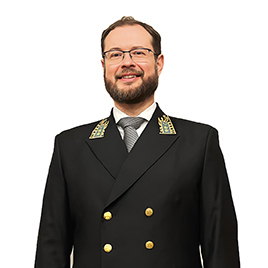
Dmitry CHUMAKOV, Deputy Permanent Representative of the Russian Federation to the United Nations, PhD in Economics
The steady advance of the Russian economic diplomacy continues unabated, including at the UN headquarters in New York. This persistent momentum haunts our adversaries, as it always has. Russia’s approach simply does not fit with their consumerist attitude towards the UN. Yet, far from deterring us, this only spurs Russian diplomats on to consistently advocate for our national perspectives and to ensure that Russia’s voice is heeded on all matters, not least those on the financial and economic agenda. There are many such matters debated in the UN General Assembly (UNGA) and the Economic and Social Council (ECOSOC), in their subsidiary committees and commissions, sometimes even in the UN Security Council, and at various UN thematic conferences, forums, and informal gatherings in New York. Throughout these numerous platforms, the Russian delegation does far more than merely sit at the table; it actively shapes decision-making. We invite readers to explore the perspective of the economic team of the Russian Permanent Mission to the UN in New York—an insider’s view, as one puts it.
RUSSIA’S UN ECONOMIC DIPLOMACY
WHO NEEDS THE UN TODAY, AND WHY?
The United Nations’ recent 80th anniversary prompted a flurry of commentary and discussion. Needless to say, the UN has faced sharp reproach for failing to live up to its founding promise. Its perceived failures include raging conflicts, shattered economies, and, more broadly, the fragmentation of the global economy. The flagship UN report, the World Economic Situation and Prospects 2026, sends out distress signals: global growth is projected to slow to 2.7%—down from 2.8% in 2025 and well below the pre-pandemic average of 3.2%.
Yet credit was given—the UN, born from the ashes of World War II, has helped prevent the world from sliding into a third global conflict.
Now, however, it is time to cut through the rhetoric and set the record straight: who needs the UN today, and why?
Western countries need the UN to cling to their fading dominance, to pressure others into doing their bidding, and to extract resources from others—all while masking their neocolonial ambitions behind lofty slogans. Yet the strain on the sprawling system of “global governance” institutions has begun to show clear failures. And the more these mechanisms fail, the more aggressive the attempted external interference and unfair competition become—particularly under the guise of human rights and climate alarmism. The intent is clear—to turn the UN into a kangaroo court, dividing nations into judges and the accused. Naturally, those casting themselves in the role of arbiters show no desire to discuss the “specks,” let alone the “beam in their own eyes.” For developing nations, however, the UN remains a platform for honest dialogue on who needs assistance and how it should be delivered. But it is more than just a talkshop—it is also a mechanism for securing aid through UN funds and programmes, supplementing bilateral support. After all, no one can live on Western preaching alone.
What makes Russia’s position unique is that, to put it bluntly, we will survive—and thrive—without the United Nations. Yet something else remains equally clear to us. As Russia’s President Putin noted in January 2026, “Russia stands for strengthening the UN’s central role in world affairs.” He emphasised the enduring relevance of the UN Charter’s core principles: equality, respect for sovereignty, non-interference in internal affairs, and the settlement of disputes through dialogue. Without these, collective approaches to shared challenges cannot be forged, nor can mutually beneficial international cooperation take root. Indeed, it is cooperation—mentioned in the very first Article of the UN Charter, following its primary commitments to peace, security, and fostering friendly, equal relations—that we regard as one of the UN’s most vital missions. Russia’s commitment to these principles is enshrined in its Foreign Policy Concept.
As a founding member, Russia bears a particular responsibility for ensuring the UN fulfils its true functions—to build and to unite. And the UN’s financial and economic sphere offers a vast field for action in this regard.
Our reputation, long-term objectives, and core values continue to underpin the steady advance mentioned earlier—by which we mean Russia’s active and globally demanded participation in shaping every significant decision. Attempts to isolate Russia only backfire.
RUSSIA’S UN ECONOMIC DIPLOMACY PRIORITIES IN PRACTICE
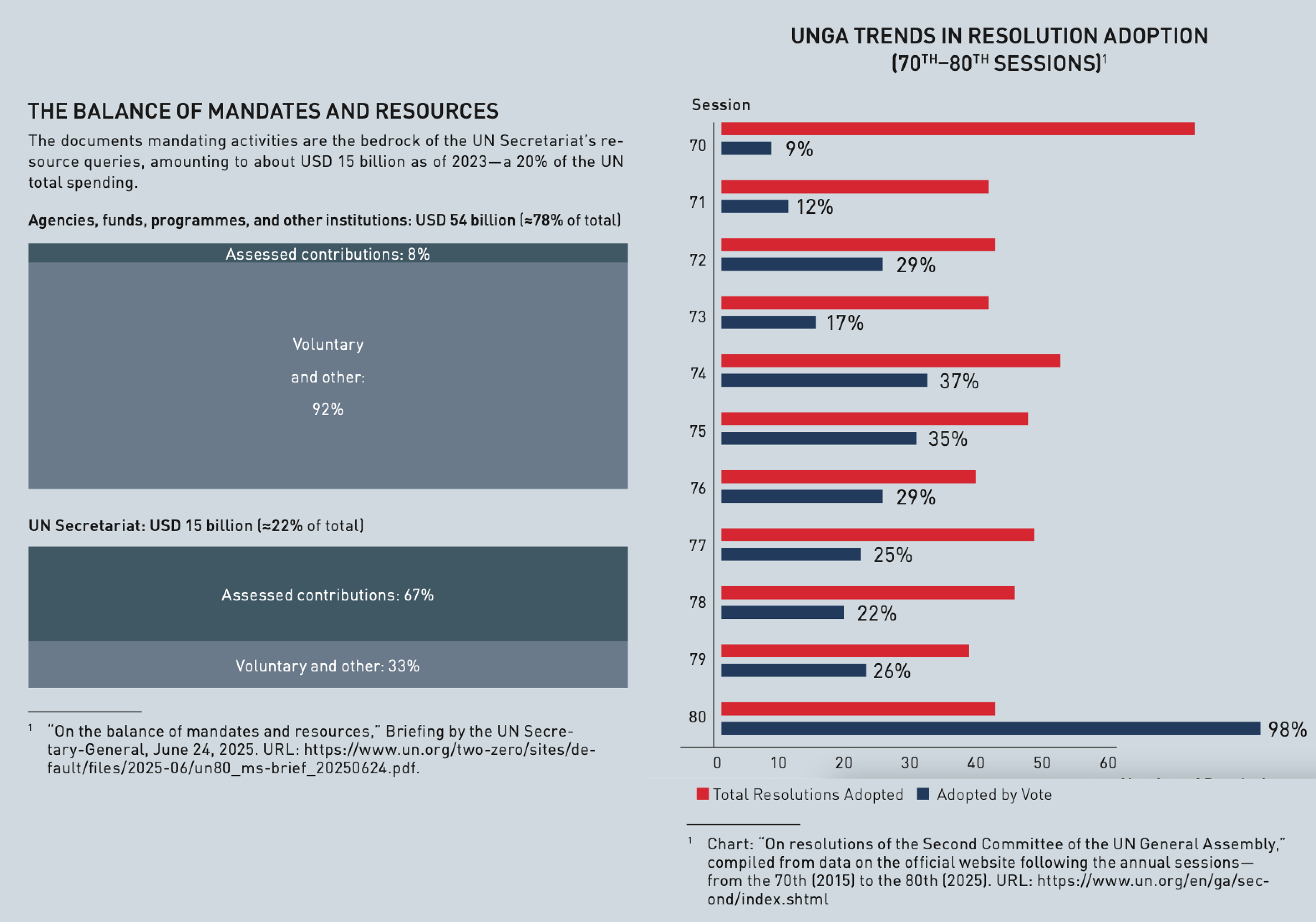
We cannot afford to stand idly by while Western countries attempt to hold the UN “hostage” to their own enrichment or, these days, to their struggle to simply stay afloat. Equally important is resisting efforts to drag UN officials into slanderous campaigns, including those directed against Russia. This is no easy task. The West’s primary lever in bending the UN to its will is financial control— the UN system depends on voluntary contributions for nearly 80% of its funding. Another way is the dominance of NATO and EU representatives in key positions within the UN Secretariat.
The current escalation of the exploitative attitude toward the UN— alongside the neocolonial ambitions of the West, which run counter to the aspirations of the global majority— has eroded the capacity for consensus among nations. This shift is evident in how resolutions are debated at the UN. Rather than being adopted by consensus (which is, after all, the very foundation of the UN), they are increasingly being pushed to a vote.
That said, we must continue to pursue consensus-building at the UN, with an emphasis on deepening partnerships with developing countries to support their sovereign growth. We need to work together to shape a multipolar world order and democratise the financial and economic architecture. The UN’s mechanisms offer a valuable platform for strengthening friendly ties with our closest allies and neighbours across the CIS, and for advancing the Eurasian integration—particularly amid the globalisation crisis.
What follows are some examples of how our priorities and approaches are being put into practice at the UN.
A key area is countering unilateral coercive measures imposed in circumvention of the UN Security Council. The Russian delegation—in coordination with developing countries—is working to condemn these practices and step up pressure on their proponents, including by expanding the body of UN documentary framework on the subject.
During the current session of the UN General Assembly, a stand-alone resolution on unilateral coercive measures was adopted (A/RES/80/120)— despite the Western states requesting a vote and losing it. We emphasise the illegitimacy of unilateral coercive measures and their colonial nature, particularly given the extraterritorial application of secondary sanctions, which currently target 76 developing countries. At Russia’s initiative, supported by like-minded partners, the UN has established the International Day against Unilateral Coercive Measures (December 4) and the Day against Colonialism (December 14). Russia advances this agenda not to complain about sanctions against it—especially since European economies alone lost an estimated EUR 1.6 trillion between 2022 and 2025. Our primary concern lies with the devastating impact of these sanctions on already vulnerable states, a consequence that the architects of coercive measures refuse to acknowledge, instead pressuring the UN Secretariat to “play along.”
The United Nations’ recent 80th anniversary prompted a flurry of commentary and discussion. Needless to say, the UN has faced sharp reproach for failing to live up to its founding promise. Its perceived failures include raging conflicts, shattered economies, and, more broadly, the fragmentation of the global economy. The flagship UN report, the World Economic Situation and Prospects 2026, sends out distress signals: global growth is projected to slow to 2.7%—down from 2.8% in 2025 and well below the pre-pandemic average of 3.2%.
Yet credit was given—the UN, born from the ashes of World War II, has helped prevent the world from sliding into a third global conflict.
Now, however, it is time to cut through the rhetoric and set the record straight: who needs the UN today, and why?
Western countries need the UN to cling to their fading dominance, to pressure others into doing their bidding, and to extract resources from others—all while masking their neocolonial ambitions behind lofty slogans. Yet the strain on the sprawling system of “global governance” institutions has begun to show clear failures. And the more these mechanisms fail, the more aggressive the attempted external interference and unfair competition become—particularly under the guise of human rights and climate alarmism. The intent is clear—to turn the UN into a kangaroo court, dividing nations into judges and the accused. Naturally, those casting themselves in the role of arbiters show no desire to discuss the “specks,” let alone the “beam in their own eyes.” For developing nations, however, the UN remains a platform for honest dialogue on who needs assistance and how it should be delivered. But it is more than just a talkshop—it is also a mechanism for securing aid through UN funds and programmes, supplementing bilateral support. After all, no one can live on Western preaching alone.
What makes Russia’s position unique is that, to put it bluntly, we will survive—and thrive—without the United Nations. Yet something else remains equally clear to us. As Russia’s President Putin noted in January 2026, “Russia stands for strengthening the UN’s central role in world affairs.” He emphasised the enduring relevance of the UN Charter’s core principles: equality, respect for sovereignty, non-interference in internal affairs, and the settlement of disputes through dialogue. Without these, collective approaches to shared challenges cannot be forged, nor can mutually beneficial international cooperation take root. Indeed, it is cooperation—mentioned in the very first Article of the UN Charter, following its primary commitments to peace, security, and fostering friendly, equal relations—that we regard as one of the UN’s most vital missions. Russia’s commitment to these principles is enshrined in its Foreign Policy Concept.
As a founding member, Russia bears a particular responsibility for ensuring the UN fulfils its true functions—to build and to unite. And the UN’s financial and economic sphere offers a vast field for action in this regard.
Our reputation, long-term objectives, and core values continue to underpin the steady advance mentioned earlier—by which we mean Russia’s active and globally demanded participation in shaping every significant decision. Attempts to isolate Russia only backfire.
RUSSIA’S UN ECONOMIC DIPLOMACY PRIORITIES IN PRACTICE
We cannot afford to stand idly by while Western countries attempt to hold the UN “hostage” to their own enrichment or, these days, to their struggle to simply stay afloat. Equally important is resisting efforts to drag UN officials into slanderous campaigns, including those directed against Russia. This is no easy task. The West’s primary lever in bending the UN to its will is financial control— the UN system depends on voluntary contributions for nearly 80% of its funding. Another way is the dominance of NATO and EU representatives in key positions within the UN Secretariat.
The current escalation of the exploitative attitude toward the UN— alongside the neocolonial ambitions of the West, which run counter to the aspirations of the global majority— has eroded the capacity for consensus among nations. This shift is evident in how resolutions are debated at the UN. Rather than being adopted by consensus (which is, after all, the very foundation of the UN), they are increasingly being pushed to a vote.
That said, we must continue to pursue consensus-building at the UN, with an emphasis on deepening partnerships with developing countries to support their sovereign growth. We need to work together to shape a multipolar world order and democratise the financial and economic architecture. The UN’s mechanisms offer a valuable platform for strengthening friendly ties with our closest allies and neighbours across the CIS, and for advancing the Eurasian integration—particularly amid the globalisation crisis.
What follows are some examples of how our priorities and approaches are being put into practice at the UN.
A key area is countering unilateral coercive measures imposed in circumvention of the UN Security Council. The Russian delegation—in coordination with developing countries—is working to condemn these practices and step up pressure on their proponents, including by expanding the body of UN documentary framework on the subject.
During the current session of the UN General Assembly, a stand-alone resolution on unilateral coercive measures was adopted (A/RES/80/120)— despite the Western states requesting a vote and losing it. We emphasise the illegitimacy of unilateral coercive measures and their colonial nature, particularly given the extraterritorial application of secondary sanctions, which currently target 76 developing countries. At Russia’s initiative, supported by like-minded partners, the UN has established the International Day against Unilateral Coercive Measures (December 4) and the Day against Colonialism (December 14). Russia advances this agenda not to complain about sanctions against it—especially since European economies alone lost an estimated EUR 1.6 trillion between 2022 and 2025. Our primary concern lies with the devastating impact of these sanctions on already vulnerable states, a consequence that the architects of coercive measures refuse to acknowledge, instead pressuring the UN Secretariat to “play along.”
The most disturbing example of UN officials’ bias in this context was their deafening silence regarding the global damage caused by unilateral coercive measures in 2022—as well as their overall stance on the Ukrainian conflict. However, our consistent engagement with UN delegations and the Secretariat, combined with well-reasoned rebuttals of Western accusations, has yielded results. Russia’s position was most comprehensively outlined in a letter from Permanent Representative Vasily Nebenzya to the UN Secretary-General, dated April 11, 2022 (later published as an official UNGA document). The harsh reality of Western neglect for starving populations became painfully evident to both affected nations and the UN Secretary-General during the implementation of the Istanbul Agreements—which were originally intended to address global food security challenges.
The global majority is increasingly observing a disconnect between the narratives and actions of the UN’s largest donor states. Even the Secretary-General has been compelled to adjust his tone, adopting a more balanced assessment of the global economic situation—as seen, for instance, in his foreword to the World Economic Situation and Prospects report mentioned earlier. The fact that “the ice is breaking”—in no small part due to our explanatory work—is further evidenced by a fairer evaluation of the impact unilateral coercive measures have on developing nations, as outlined in the relevant Secretary-General’s 2025 report.
The Russian delegation plays an active role in negotiating UN General Assembly resolutions on macroeconomic matters. Much of the preparatory work takes place within the UNGA Second Committee. The most contentious resolutions—those concerning the international financial system and development, such as UNGA Resolution 80/122— often end in votes that Western states lose. In essence, this document, backed by Russia, highlighted the urgent need for reform in the IMF’s quota calculations and governance structure. We also managed to advance other key positions, including the need for broader use of local currencies in cross-border settlements, particularly in trade and investment. Additionally, we have secured recognition of the St. Petersburg International Economic Forum’s significance in global economic discussions. While the UN’s “pointing finger” does not guarantee immediate results, the momentum for reforming the global financial architecture is now irreversible.
Striking confirmation of this came in 2024, when the UN General Assembly—backed by our
delegation—adopted a decision to establish an intergovernmental ad hoc committee to draft a UN framework convention on tax matters. Unlike past international regulations in this field this convention will stand in marked contrast to the international regulations of the past, when tax rules were thrashed out behind closed doors within the OECD—a body that has rather failed to live up to its global ambitions.
Another key area is the information and communication technology (ICT) sector, including artificial intelligence (AI). We consider it essential to support developing nations in bridging the digital divide, and we stand in solidarity with them on this front. A case in point was the successful negotiation of a UN General Assembly resolution reviewing the outcomes of the World Summit on the Information Society. This same spirit of unity defines our approach to AI governance, where we promote the central role to be given to the UN. As Deputy Foreign Minister Alexander Alimov emphasised at the New Delhi AI Summit on February 20: “...there is a need for careful consideration of each other’s aspirations and interests, as well as the risks and threats to information security that states face. We count on the commitment of all states to one of the core principles of the UN Charter—international cooperation—that will guide all states toward the best possible solutions for AI.” Russia’s economic diplomacy in New York operates across a broad spectrum of areas, including global health and education, humanitarian response, climate and energy policy, government-business coordination, demography, statistical work, among others.
The global majority is increasingly observing a disconnect between the narratives and actions of the UN’s largest donor states. Even the Secretary-General has been compelled to adjust his tone, adopting a more balanced assessment of the global economic situation—as seen, for instance, in his foreword to the World Economic Situation and Prospects report mentioned earlier. The fact that “the ice is breaking”—in no small part due to our explanatory work—is further evidenced by a fairer evaluation of the impact unilateral coercive measures have on developing nations, as outlined in the relevant Secretary-General’s 2025 report.
The Russian delegation plays an active role in negotiating UN General Assembly resolutions on macroeconomic matters. Much of the preparatory work takes place within the UNGA Second Committee. The most contentious resolutions—those concerning the international financial system and development, such as UNGA Resolution 80/122— often end in votes that Western states lose. In essence, this document, backed by Russia, highlighted the urgent need for reform in the IMF’s quota calculations and governance structure. We also managed to advance other key positions, including the need for broader use of local currencies in cross-border settlements, particularly in trade and investment. Additionally, we have secured recognition of the St. Petersburg International Economic Forum’s significance in global economic discussions. While the UN’s “pointing finger” does not guarantee immediate results, the momentum for reforming the global financial architecture is now irreversible.
Striking confirmation of this came in 2024, when the UN General Assembly—backed by our
delegation—adopted a decision to establish an intergovernmental ad hoc committee to draft a UN framework convention on tax matters. Unlike past international regulations in this field this convention will stand in marked contrast to the international regulations of the past, when tax rules were thrashed out behind closed doors within the OECD—a body that has rather failed to live up to its global ambitions.
Another key area is the information and communication technology (ICT) sector, including artificial intelligence (AI). We consider it essential to support developing nations in bridging the digital divide, and we stand in solidarity with them on this front. A case in point was the successful negotiation of a UN General Assembly resolution reviewing the outcomes of the World Summit on the Information Society. This same spirit of unity defines our approach to AI governance, where we promote the central role to be given to the UN. As Deputy Foreign Minister Alexander Alimov emphasised at the New Delhi AI Summit on February 20: “...there is a need for careful consideration of each other’s aspirations and interests, as well as the risks and threats to information security that states face. We count on the commitment of all states to one of the core principles of the UN Charter—international cooperation—that will guide all states toward the best possible solutions for AI.” Russia’s economic diplomacy in New York operates across a broad spectrum of areas, including global health and education, humanitarian response, climate and energy policy, government-business coordination, demography, statistical work, among others.
All of this is backed up not by words, but by deeds—through our participation in international development assistance to support countries, with priority attention given to our closest neighbours in the CIS and the most vulnerable nations across Africa, Asia and Latin America. Our Permanent Mission plays an active role in shaping projects implemented by Russia through the UN. Their standard budgets typically range from one to several million dollars, and they naturally cannot compete with the financial scale of Western development cooperation—donors who flaunt their billion-dollar contributions (financed through unbridled money-printing and the accumulation of unsecured debt). Yet the superficiality of Western aid, its ultimatum-driven nature, and its true underlying objectives are becoming ever more apparent—a picture further exacerbated by the prospect of such assistance being cut back. As Russian Deputy Minister of Foreign Affairs, Aleksandr Pankin, emphasised in July 2025 at the Fourth International Conference on Financing for Development in Seville, Spain: “We have reached a situation where the largest donors and international financial institutions refuse to support entire regions, while channelling disproportionately large sums—on political grounds—to the Kyiv regime: a third of all IMF lending programmes, and more than Africa as a whole receives from the World Bank.” This stands in stark contrast to the development assistance projects implemented by Russia in partnership with UN development system agencies (UNDP, UNICEF, FAO, UNIDO, etc.). Russian assistance focuses on project quality, long-term goals and the interests of recipient states.
CONCLUSION
The clash between destructive and constructive approaches, the erosion of consensus-building that fuels global upheavals, and the “wolves in sheep’s clothing” preying on vulnerable nations—while none of this is new to the UN, it has all come to weigh heavily upon it, hindering progress. And yet, the UN’s role as a platform for coordinating national interests remains undeniable, particularly when a multipolar world order is taking shape. Moving forward, nations must shift their focus from “global governance” to “global coordination”— a distinction of profound importance. Russia remains committed to contributing to this process, leveraging the UN’s existing mechanisms while advancing its own priorities.
CONCLUSION
The clash between destructive and constructive approaches, the erosion of consensus-building that fuels global upheavals, and the “wolves in sheep’s clothing” preying on vulnerable nations—while none of this is new to the UN, it has all come to weigh heavily upon it, hindering progress. And yet, the UN’s role as a platform for coordinating national interests remains undeniable, particularly when a multipolar world order is taking shape. Moving forward, nations must shift their focus from “global governance” to “global coordination”— a distinction of profound importance. Russia remains committed to contributing to this process, leveraging the UN’s existing mechanisms while advancing its own priorities.
The economic desk of Russia’s Permanent Mission to the UN in New York is more than just a well-coordinated team—it is a vital element of the diplomatic blood stream that links together like-minded professionals not only in Moscow but across the globe— in Russian embassies and missions to various UN bodies, as well as within international organisations such as the G20, BRICS, SCO, and EAEU. To be part of this system is both an honour and a weighty responsibility—as well as a source of immense pleasure in collaborating with true professionals, all operating on the same wavelength. That is the key to our shared success.