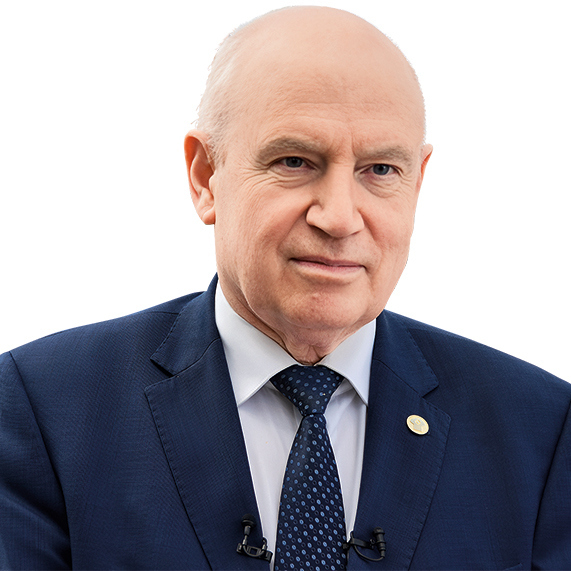
The world is currently undergoing a profound transformation amid a geopolitical escalation and a deepening economic crisis. Traditional production and supply chains fracture, protectionist policies gain ground, and sanctions turn into a tool of pressure and advancement of national interests—all this puts energy, food and financial markets out of balance. This destabilisation, in turn, fuels inflation and leads to a decline in demand for goods, a fall in output, and rising unemployment. In this context, developing a substantial regional market, identifying new growth points and long term drivers for mutually beneficial cooperation are of critical importance.
– Sergey LEBEDEV, Secretary General, Commonwealth of Independent States (CIS)
CIS MARKS 35TH ANNIVERSARY:
OUTCOMES AND PROSPECTS

The Commonwealth of Independent States (CIS), which marks its 35th anniversary in 2026, is known to be the oldest, most representative and largest integration association in the post-Soviet space. Over the years, the Commonwealth has evolved into a unique platform for sustained constructive engagement between our countries across the political, legal, social, financial, humanitarian, scientific, technical and other fields.
Moulded by global economic and political shifts, the strategic goals and objectives of the CIS are evolving, a new vision to achieve them is taking shape, and existing projects undergo the necessary fine-tuning. The CIS Concept of Further Development, updated in 2020, alongside the relevant strategic texts adopted across various sectors, sets the vector for the CIS’s future development and encompasses all the most pressing challenges of today faced by the association.
A key pillar of cooperation within the CIS, a vital platform for regional economic stability, is mutually beneficial partnership in trade and economy. Despite the challenging geopolitical climate and considerable external pressure, the CIS countries continue to show positive dynamics in their key macroeconomic indicators.
Moulded by global economic and political shifts, the strategic goals and objectives of the CIS are evolving, a new vision to achieve them is taking shape, and existing projects undergo the necessary fine-tuning. The CIS Concept of Further Development, updated in 2020, alongside the relevant strategic texts adopted across various sectors, sets the vector for the CIS’s future development and encompasses all the most pressing challenges of today faced by the association.
A key pillar of cooperation within the CIS, a vital platform for regional economic stability, is mutually beneficial partnership in trade and economy. Despite the challenging geopolitical climate and considerable external pressure, the CIS countries continue to show positive dynamics in their key macroeconomic indicators.
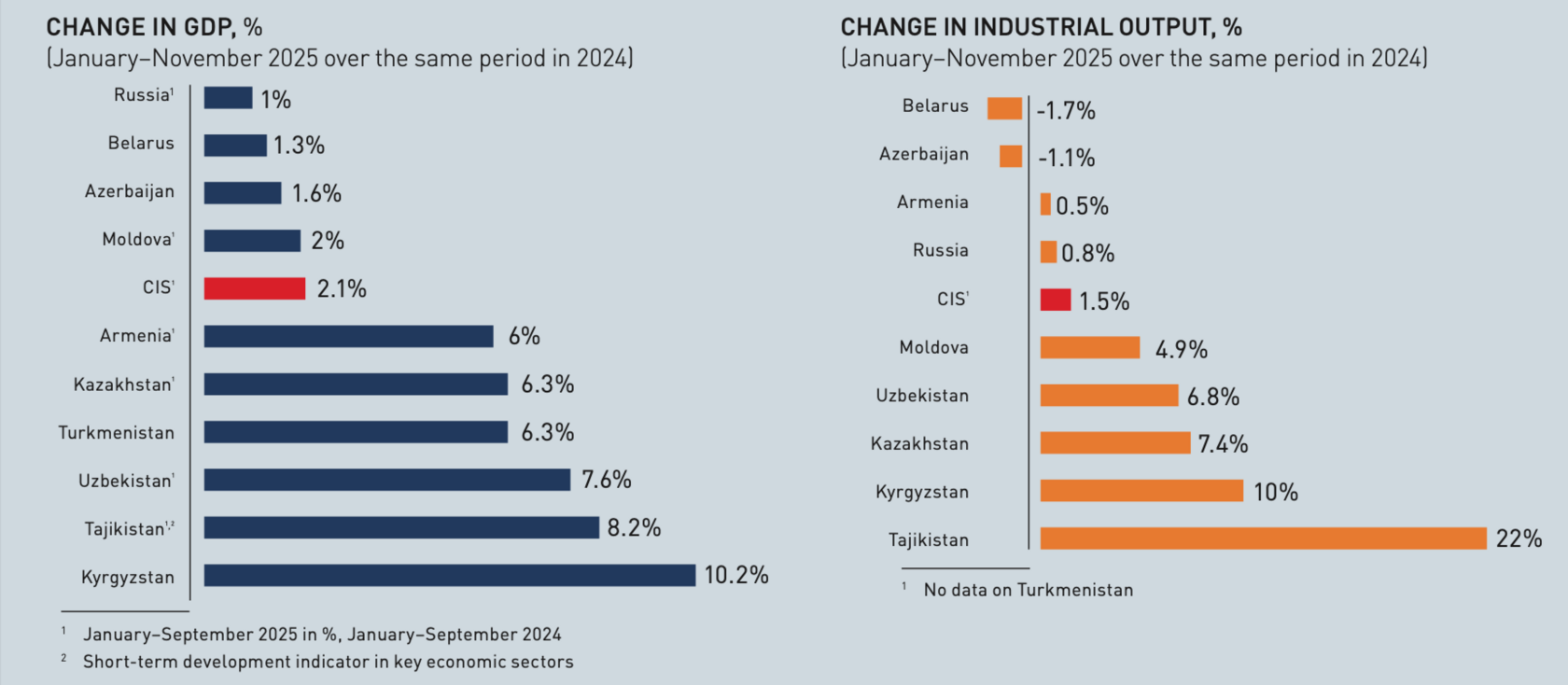
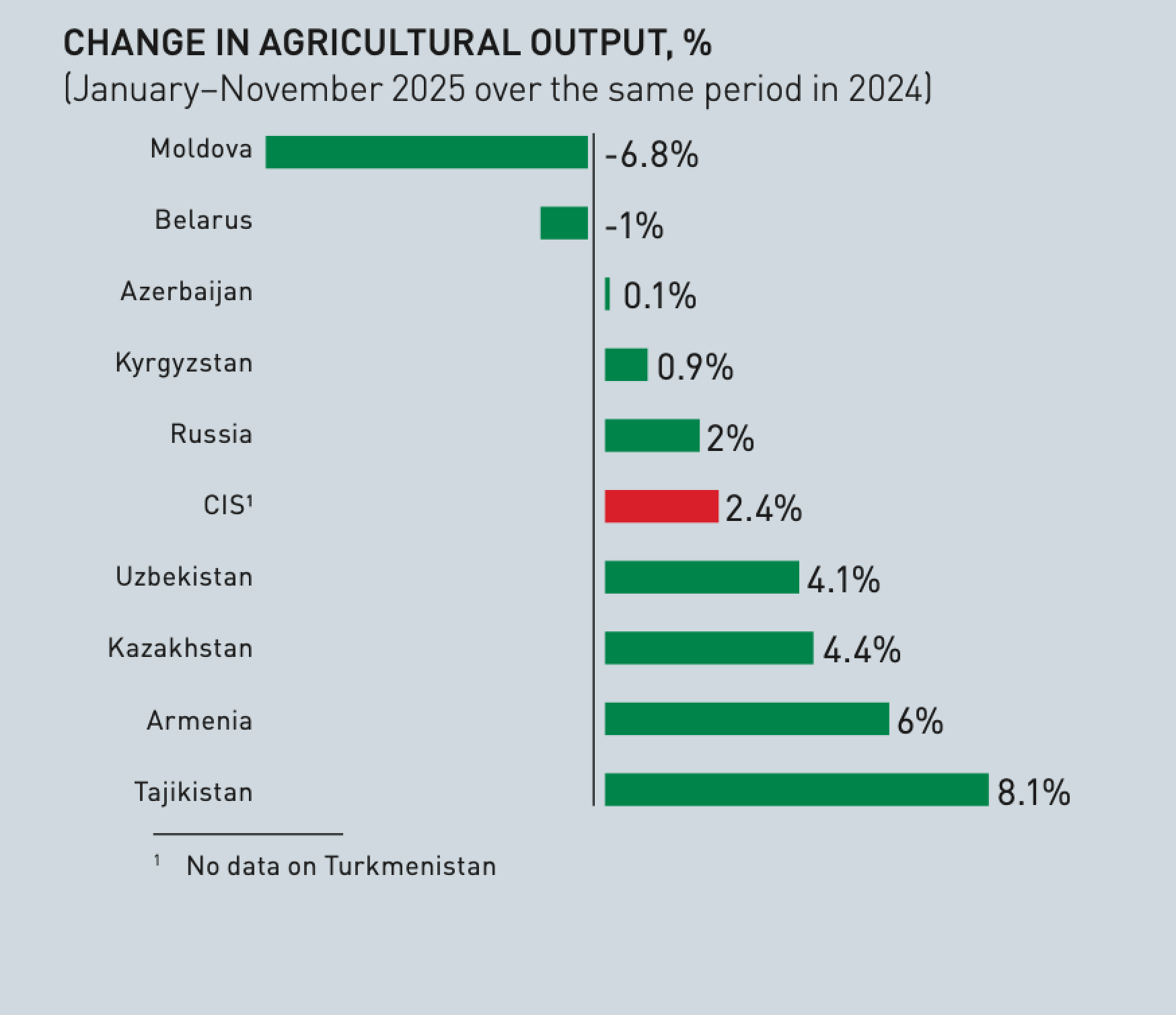
Thus, for January–November 2025 the GDP growth across the CIS countries stood at 2.1%. In most Commonwealth states, this figure exceeded 6% over the same period last year, exceeding global averages. The strongest performances were recorded in Kyrgyzstan (10.2%), Tajikistan (8.2%) and Uzbekistan (7.6%). Expert forecasts suggest this positive trend will continue in the near future.
A powerful driver of expanding trade and economic cooperation in the region is the free trade area (FTA), established under the agreement signed in 2011. The scale and scope of cooperation in terms of supplies and goods between the CIS countries continue to expand steadily, with mutual trade volumes consistently on the rise. For January–November 2025 a significant increase in this indicator was recorded in Azerbaijan (7.2%), Tajikistan (12.7%), and Uzbekistan (11.7%).
A powerful driver of expanding trade and economic cooperation in the region is the free trade area (FTA), established under the agreement signed in 2011. The scale and scope of cooperation in terms of supplies and goods between the CIS countries continue to expand steadily, with mutual trade volumes consistently on the rise. For January–November 2025 a significant increase in this indicator was recorded in Azerbaijan (7.2%), Tajikistan (12.7%), and Uzbekistan (11.7%).
It is worth highlighting the importance of the 2023 Agreement on Free Trade in Services, Establishment, Operations and Investment. As experts say, the provisions agreed could boost mutual trade in services among signatories by up to 25% and increase mutual investment by 30% in the medium term. This marks a new level of integration, opening up new opportunities for capital, expertise and, in the long run, joint business ventures.
To help improve the investment climate and create additional incentives for business cooperation, a Comprehensive Package of Measures up to 2030 has been adopted to attract and stimulate mutual investments within the CIS.
In today’s context, the use of global currencies in international settlements comes with high risks, including asset freezes and transaction blocks. In this regard, a steady trend towards de-dollarisation has emerged, accompanied by a consistent growth in the share of mutual settlements in national currencies. Experts indicate that in 2024–2025 this share reached 96% within the CIS and 93% in the EAEU.
Thirty-five years is a significant milestone for an integration association, serving as a moment both to take stock and to chart long-term prospects. The CIS member states have identified key objectives and priorities for their future socioeconomic development.
The fundamental document in the economic field is the CIS Economic Development Strategy for the period up to 2030. It sets out harmonised approaches to the objectives, core tasks and directions of economic cooperation.
The mechanism to implement the Strategy—divided into two stages (2021–2025 and 2026–2030)— is provided by the associated Action Plan. The first stage of the Plan was successfully concluded in 2025, with significant results achieved on the majority of its provisions.
On September 29, 2025, the second stage was adopted by the CIS Council of Heads of Government. Drafted amid profound shifts both in the framework of international trade and economic relations and in the global economy itself, the document is designed to foster sustainable growth and to improve the well-being of the population. It also includes key projects such as the Concept for Linking Major Transport Arteries across the CIS space and the Strategy for the Development of the Fuel and Energy Complex until 2035.
To help improve the investment climate and create additional incentives for business cooperation, a Comprehensive Package of Measures up to 2030 has been adopted to attract and stimulate mutual investments within the CIS.
In today’s context, the use of global currencies in international settlements comes with high risks, including asset freezes and transaction blocks. In this regard, a steady trend towards de-dollarisation has emerged, accompanied by a consistent growth in the share of mutual settlements in national currencies. Experts indicate that in 2024–2025 this share reached 96% within the CIS and 93% in the EAEU.
Thirty-five years is a significant milestone for an integration association, serving as a moment both to take stock and to chart long-term prospects. The CIS member states have identified key objectives and priorities for their future socioeconomic development.
The fundamental document in the economic field is the CIS Economic Development Strategy for the period up to 2030. It sets out harmonised approaches to the objectives, core tasks and directions of economic cooperation.
The mechanism to implement the Strategy—divided into two stages (2021–2025 and 2026–2030)— is provided by the associated Action Plan. The first stage of the Plan was successfully concluded in 2025, with significant results achieved on the majority of its provisions.
On September 29, 2025, the second stage was adopted by the CIS Council of Heads of Government. Drafted amid profound shifts both in the framework of international trade and economic relations and in the global economy itself, the document is designed to foster sustainable growth and to improve the well-being of the population. It also includes key projects such as the Concept for Linking Major Transport Arteries across the CIS space and the Strategy for the Development of the Fuel and Energy Complex until 2035.
Other pressing areas of mutual cooperation include digital transformation—spanning most economic sectors—and cutting-edge AI technologies. A comprehensive vision for joint action in this area is set out in the provisions of the CIS Strategy for Cooperation in the Development of the Information Society and the Digital Economy for the period up to 2035, the Strategy for Digitalisation of Multimodal Transport Corridors, and the Concept for the Digital Transformation of the Chemical Industry.
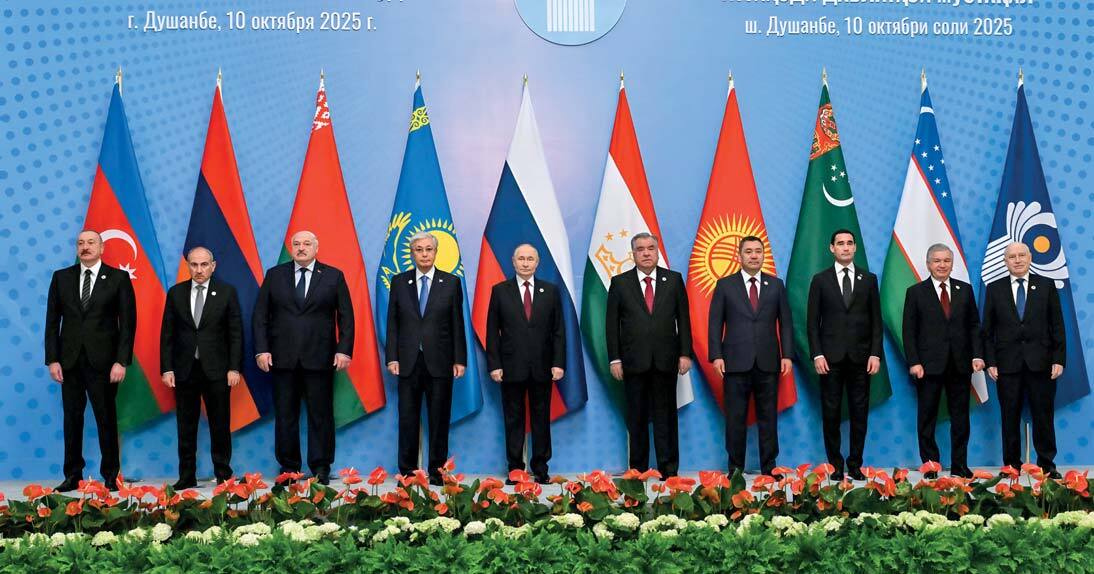
The year 2025 marked the Tajikistani successful CIS chairmanship, which aimed at delivering practical results in cooperation, enhancing the effectiveness of inter-state mechanisms, and adapting the CIS framework to shifting international realities with an emphasis on integration and sustainable development. The year’s work culminated in a number of landmark decisions aimed at ensuring security across the CIS and deepening cooperation in the military technical, economic, cultural, humanitarian and political fields. Further on, a UN General Assembly resolution Cooperation between the United Nations and the Commonwealth of Independent States was adopted; the “CIS+” format was agreed upon; and the SCO was granted observer status with the CIS, opening a new chapter in the engagement between the Eurasian regional bodies.
On January 1, 2026, Turkmenistan assumed the CIS chairmanship, marking its second term in the CIS history, the first dating back to 2019. The concept for its chairmanship is aimed first and foremost at strengthening integration within the CIS, developing economic cooperation and transport and logistics capacities, and expanding collaboration in the cultural and humanitarian areas. At the initiative of Turkmenistan, 2027 will be declared the Year of Transport Connectivity in the CIS.
The interaction between Commonwealth countries continues to evolve in the midst of change, shaping new initiatives and fresh ideas. The key is to identify new growth drivers in good time and to incorporate them into existing projects and programmes. In this context, cooperation between the CIS and other international organisations takes on particular importance.
In short, ambitious tasks are ahead—chief among them ensuring, over the medium term, the multifaceted cooperation within the CIS.
Over the past 35 years, the CIS has accumulated a wealth of experience in long-term engagement with other integration associations, and it has in many respects been positive. At various stages of its development, different types of integration structures have been formed and are successfully operating, including the Union State and the Eurasian Economic Union. It is also important to strengthen interaction with such significant integration bodies as the EAEU, CSTO, SCO, BRICS, and ECO.
The CIS, serving as a much-demanded platform for comprehensive dialogue, has built a solid legal foundation and the necessary cooperation mechanisms over a wide range of issues—from politics and security to economy, culture, and humanitarian ties. It is no accident that the CIS is often described as a “laboratory of integration”—it is here that many formats were first tested, later to be developed within deeper integrated associations.
The EAEU—a prime example of such deeper development—is centred on creating a single market and endowed with supranational powers, its high pace and effectiveness in economy are only to be expected—that is the way it was designed from the very start.
We see the EAEU’s successes as a stimulus for the development of the Commonwealth. Our joint efforts help us to withstand external pressure.
To that end, we are carefully studying and adapting the EAEU’s experience—whether in creating a barrier-free environment or in digitalisation—for application within the broader CIS framework. Our premise is that the best the EAEU has to offer can, and should, be put to use across the Commonwealth.
Our shared task today, therefore, is to harness the synergy of all the integration bodies across Eurasia to improve the well-being of our citizens and foster business cooperation throughout the region.
The year 2025 marked the Tajikistani successful CIS chairmanship, which aimed at delivering practical results in cooperation, enhancing the effectiveness of inter-state mechanisms, and adapting the CIS framework to shifting international realities with an emphasis on integration and sustainable development. The year’s work culminated in a number of landmark decisions aimed at ensuring security across the CIS and deepening cooperation in the military technical, economic, cultural, humanitarian and political fields. Further on, a UN General Assembly resolution Cooperation between the United Nations and the Commonwealth of Independent States was adopted; the “CIS+” format was agreed upon; and the SCO was granted observer status with the CIS, opening a new chapter in the engagement between the Eurasian regional bodies.
On January 1, 2026, Turkmenistan assumed the CIS chairmanship, marking its second term in the CIS history, the first dating back to 2019. The concept for its chairmanship is aimed first and foremost at strengthening integration within the CIS, developing economic cooperation and transport and logistics capacities, and expanding collaboration in the cultural and humanitarian areas. At the initiative of Turkmenistan, 2027 will be declared the Year of Transport Connectivity in the CIS.
The interaction between Commonwealth countries continues to evolve in the midst of change, shaping new initiatives and fresh ideas. The key is to identify new growth drivers in good time and to incorporate them into existing projects and programmes. In this context, cooperation between the CIS and other international organisations takes on particular importance.
In short, ambitious tasks are ahead—chief among them ensuring, over the medium term, the multifaceted cooperation within the CIS.
Over the past 35 years, the CIS has accumulated a wealth of experience in long-term engagement with other integration associations, and it has in many respects been positive. At various stages of its development, different types of integration structures have been formed and are successfully operating, including the Union State and the Eurasian Economic Union. It is also important to strengthen interaction with such significant integration bodies as the EAEU, CSTO, SCO, BRICS, and ECO.
The CIS, serving as a much-demanded platform for comprehensive dialogue, has built a solid legal foundation and the necessary cooperation mechanisms over a wide range of issues—from politics and security to economy, culture, and humanitarian ties. It is no accident that the CIS is often described as a “laboratory of integration”—it is here that many formats were first tested, later to be developed within deeper integrated associations.
The EAEU—a prime example of such deeper development—is centred on creating a single market and endowed with supranational powers, its high pace and effectiveness in economy are only to be expected—that is the way it was designed from the very start.
We see the EAEU’s successes as a stimulus for the development of the Commonwealth. Our joint efforts help us to withstand external pressure.
To that end, we are carefully studying and adapting the EAEU’s experience—whether in creating a barrier-free environment or in digitalisation—for application within the broader CIS framework. Our premise is that the best the EAEU has to offer can, and should, be put to use across the Commonwealth.
Our shared task today, therefore, is to harness the synergy of all the integration bodies across Eurasia to improve the well-being of our citizens and foster business cooperation throughout the region.