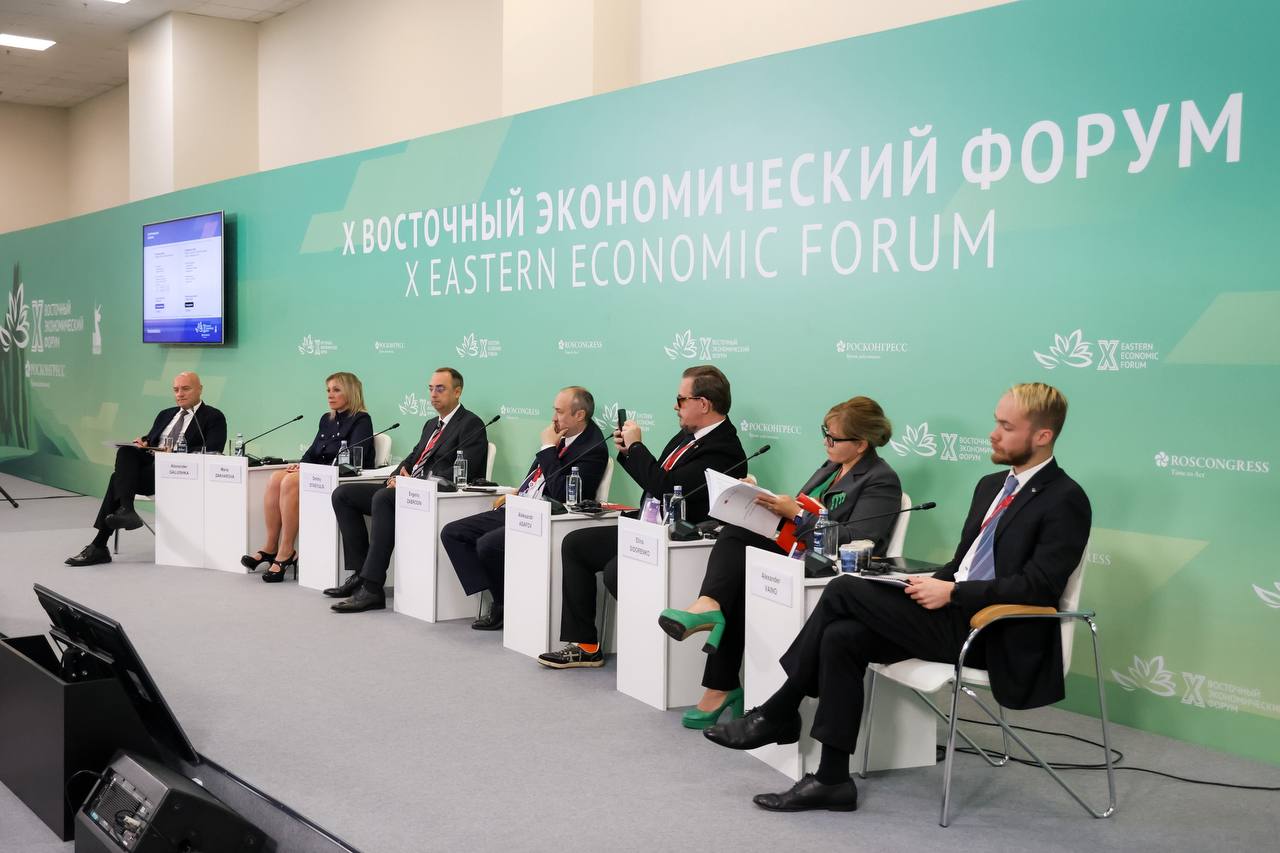
On September 3, at the session "Measuring the Social Impact of AI: Progress, Risks, and Development Paths," experts discussed the responsible development of artificial intelligence, the strategic priority and desired vision of Russia's digital future, the harmonious implementation and legal regulation of AI, technological sovereignty, and other pressing issues on the agenda.
Maria Zakharova, Director of the Information and Press Department of the Russian Ministry of Foreign Affairs, highlighted the main personal and societal risks of using AI:
Dmitry Stasyulis, President of the International Union of Economists and Russia's Sherpa at the Civil 20, discussed issues related to organizing international cooperation in the development and regulation of artificial intelligence.
In particular, the Civil 20 discusses and agrees on a common vision for AI standards, ethics, and protocols, and develops initiatives on data management and innovation. Dmitry Stasyulis emphasized that civil society must actively participate in developing effective solutions for the use and implementation of artificial intelligence: "The process of developing artificial intelligence, risk management, and protocols is not isolated and must proceed through collaboration and international partnership.
Civil society and the public must participate in the discussion of these issues due to their direct involvement. In practice, the public's acceptance or rejection of a particular government-proposed AI solution can have a decisive impact on its actual implementation, again taking into account the development and state of modern technologies."
The meeting was also attended by Alexander Asafov, First Deputy Chairman of the Moscow Civic Chamber's Commission for Civil Society Development and Public Oversight; Alexander Vaino, Director of the Young Professionals Division at the Agency for Strategic Initiatives (ASI); Mlindi Mashologu, Deputy Minister of Communications and Digital Technologies of the Republic of South Africa for the Development of the Digital Society and Economy; and other experts.
Maria Zakharova, Director of the Information and Press Department of the Russian Ministry of Foreign Affairs, highlighted the main personal and societal risks of using AI:
- Personal threats include the loss of analytics and independence, the illusion of creativity instead of real creativity, and emotional dependence on neural networks, which threatens relationships.
- For society, these include the erosion of cultural diversity, the use of AI as a tool of neocolonialism, and a sharp increase in deepfakes: in 2025, their number has tripled compared to last year.
Dmitry Stasyulis, President of the International Union of Economists and Russia's Sherpa at the Civil 20, discussed issues related to organizing international cooperation in the development and regulation of artificial intelligence.
In particular, the Civil 20 discusses and agrees on a common vision for AI standards, ethics, and protocols, and develops initiatives on data management and innovation. Dmitry Stasyulis emphasized that civil society must actively participate in developing effective solutions for the use and implementation of artificial intelligence: "The process of developing artificial intelligence, risk management, and protocols is not isolated and must proceed through collaboration and international partnership.
Civil society and the public must participate in the discussion of these issues due to their direct involvement. In practice, the public's acceptance or rejection of a particular government-proposed AI solution can have a decisive impact on its actual implementation, again taking into account the development and state of modern technologies."
The meeting was also attended by Alexander Asafov, First Deputy Chairman of the Moscow Civic Chamber's Commission for Civil Society Development and Public Oversight; Alexander Vaino, Director of the Young Professionals Division at the Agency for Strategic Initiatives (ASI); Mlindi Mashologu, Deputy Minister of Communications and Digital Technologies of the Republic of South Africa for the Development of the Digital Society and Economy; and other experts.