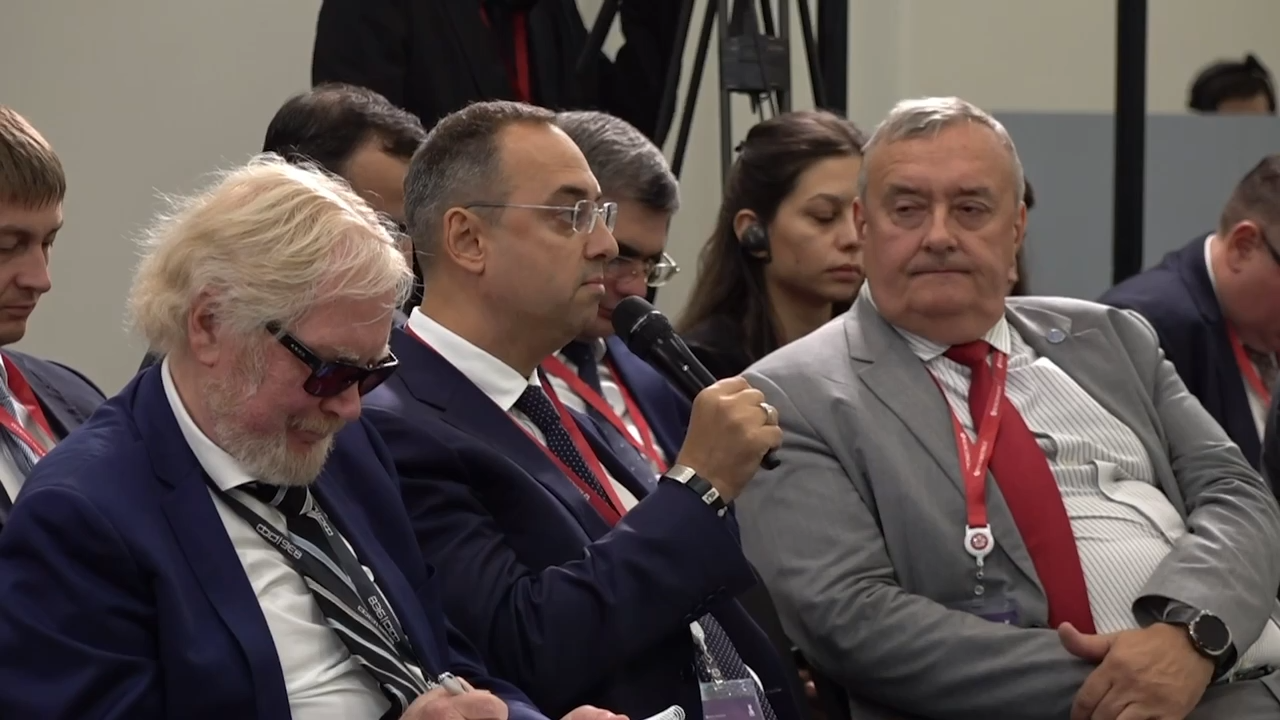
On September 4, the session "Greater Eurasian Partnership: New Paradigms for the Continent's Development" took place today at the 10th Eastern Economic Forum at the Eastern Economic Forum 2025.
Experts discussed the GEP's potential for developing Eurasia into a unified economic space.
Alexey Overchuk, Deputy Prime Minister of the Russian Federation, outlined the goal of the GEP: creating an economic framework for Eurasia to mitigate the costs of global crises and strengthen the region's position in the global system. The Deputy Prime Minister emphasized that the initiative entails expanding the network of free trade zones, developing transport corridors, digital space, and energy security.
Andrey Slepnev, Minister for Trade of the Eurasian Economic Commission, noted that the EAEU serves as the core of the GEP and the foundation of a competitive Eurasian space. The association is forming a network of free trade zones. Agreements have already been concluded with Vietnam, China, Iran, the UAE, and Mongolia, and negotiations with India and Pakistan are in the final stages. Within the EAEU, the digitalization of logistics and industrial cooperation are being developed, and uniform standards and supragovernmental regulatory formats are being developed.
Andrey Klimov, Deputy Chairman of the Federation Council Committee on International Affairs of the Russian Federation, emphasized that the key to implementing the BEP is trust and the formation of a common framework for security and cooperation. Unlike Africa and Latin America, Eurasia does not have a unified structure, so integration is built around the EAEU, the CIS, and the SCO. The BEP is designed to unite these formats and create a coherent architecture of interaction on the continent.
Dmitry Stasyulis, President of the International Economic Union and Russia's Sherpa at the Civil 20, added that consolidating the efforts of government, civil society, and experts will help build trust. He also announced that the final Civil 20 memorandum for G20 leaders will include provisions on supporting and developing the BEP.
Dmitry Stasyulis emphasized that within the framework of the BEP, it is necessary to create common mechanisms for legal protection of businesses, including a unified arbitration system and a procedure for recognizing court decisions.
Experts discussed the GEP's potential for developing Eurasia into a unified economic space.
Alexey Overchuk, Deputy Prime Minister of the Russian Federation, outlined the goal of the GEP: creating an economic framework for Eurasia to mitigate the costs of global crises and strengthen the region's position in the global system. The Deputy Prime Minister emphasized that the initiative entails expanding the network of free trade zones, developing transport corridors, digital space, and energy security.
Andrey Slepnev, Minister for Trade of the Eurasian Economic Commission, noted that the EAEU serves as the core of the GEP and the foundation of a competitive Eurasian space. The association is forming a network of free trade zones. Agreements have already been concluded with Vietnam, China, Iran, the UAE, and Mongolia, and negotiations with India and Pakistan are in the final stages. Within the EAEU, the digitalization of logistics and industrial cooperation are being developed, and uniform standards and supragovernmental regulatory formats are being developed.
Andrey Klimov, Deputy Chairman of the Federation Council Committee on International Affairs of the Russian Federation, emphasized that the key to implementing the BEP is trust and the formation of a common framework for security and cooperation. Unlike Africa and Latin America, Eurasia does not have a unified structure, so integration is built around the EAEU, the CIS, and the SCO. The BEP is designed to unite these formats and create a coherent architecture of interaction on the continent.
Dmitry Stasyulis, President of the International Economic Union and Russia's Sherpa at the Civil 20, added that consolidating the efforts of government, civil society, and experts will help build trust. He also announced that the final Civil 20 memorandum for G20 leaders will include provisions on supporting and developing the BEP.
Dmitry Stasyulis emphasized that within the framework of the BEP, it is necessary to create common mechanisms for legal protection of businesses, including a unified arbitration system and a procedure for recognizing court decisions.